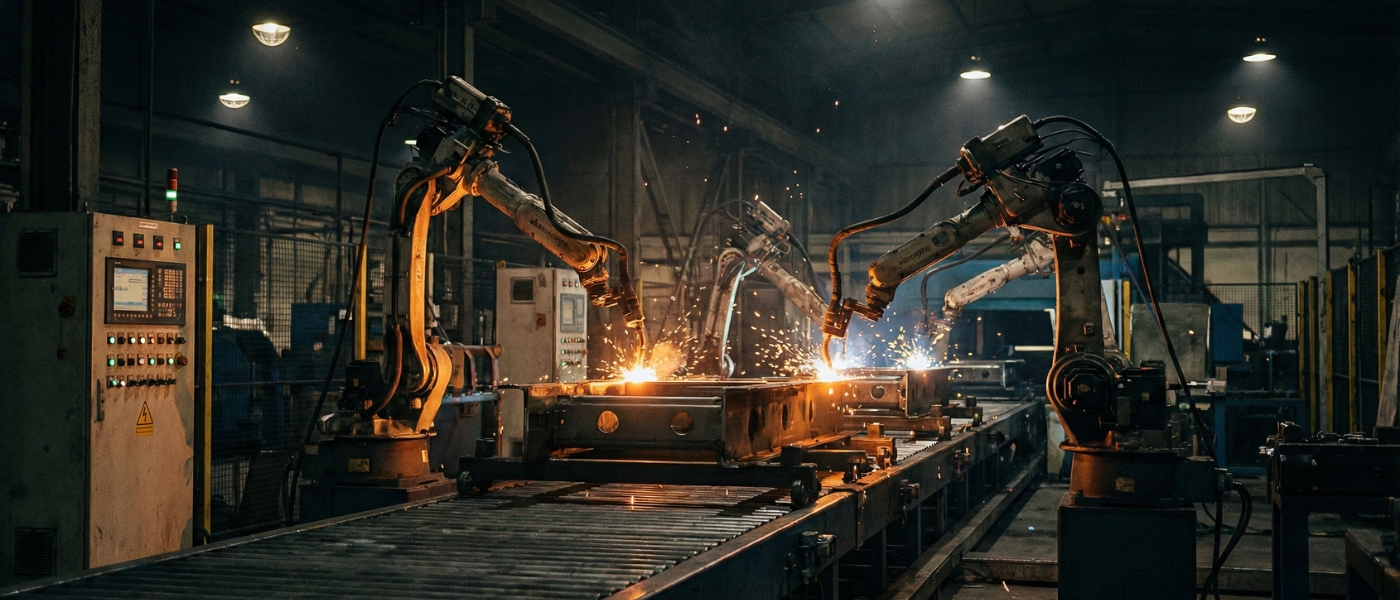
The silent revolution of dark factories
The emergence of dark factories, or lights-out manufacturing, marks a profound rupture in the story of industrial production. Once considered a futuristic concept, fully autonomous factories now operate quietly across sectors such as electronics, automotive components, and precision manufacturing—often running 24/7 without requiring human presence. This shift embodies more than technological innovation; it signals a structural reconfiguration in how nations build industrial competitiveness. The relentless pursuit of efficiency, speed, and cost-optimization pushes companies to embrace robotic precision over traditional labor-intensive models.
Beyond the technological hype lies a more subtle industrial logic. Dark factories are the natural consequence of decades of process optimization, supply chain pressure, and the relentless demand for speed in global markets. As companies face volatile energy costs, shrinking margins, and fierce global competition, the temptation of “uninterrupted, perfect repetition” becomes irresistible. Robotics no longer simply assist human operators— they now replace them in environments where predictability and precision are paramount.
Yet this milestone also raises deeper questions about how societies interpret technological progress. Dark factories symbolize not only innovation but also disconnection: the disappearance of human presence from the production line. This transition forces policymakers and business leaders to reflect on how industrial power is measured—through employment, productivity, or strategic autonomy? The debate is only beginning.
Operational excellence reimagined
At the core of dark factory strategy lies a radical promise: eliminating variability. Robots do not tire, negotiate breaks, or fluctuate in performance; their output remains consistent across the year. This operational stability fundamentally transforms cost structures. Reduced downtime, predictive maintenance, and hyper-optimized workflows allow companies to scale production without the constraints of human labor cycles. In an age where supply chain fragility is the new norm, dark factories offer a seductive shield against disruptions.
The integration of advanced AI-driven analytics, robotics, sensors, and digital twins allows production to adapt in real time. These systems simulate failures before they occur, redirect flows autonomously, and continuously refine micro-processes with data-driven precision. While human workers excel at interpretation and creativity, machines excel at repetition and risk exposure. Dark factories therefore allocate risk to robots and decision-making to algorithms—reshaping the managerial role into one of strategic oversight rather than operational command.
Still, this unprecedented efficiency carries a paradox. As factories become “perfectly efficient,” they also become less flexible. A fully automated plant is extraordinarily powerful under stable conditions but less agile when market demands shift rapidly. Retooling robots and rewriting complex automation workflows can cost more than retraining a human workforce. Thus, dark factories are not a universal solution; they are a high-stakes industrial bet that favors long-term predictability over adaptability.
The social and ethical dilemma
The disappearance of human operators from production lines presents one of the most sensitive chapters of industrial transition. Dark factories may reduce operational costs, but they also displace traditional manufacturing jobs, historically a social anchor for millions of families. Workers without reskilling opportunities risk being sidelined by a system that values digital competencies over manual experience. This shift challenges the social contract between industry, workers, and governments.
However, the narrative is more nuanced than simple job loss. While manual roles shrink, demand rises for technicians, automation engineers, data analysts, cybersecurity specialists, and industrial AI supervisors. The true challenge is the gap between the workforce we have and the competencies the industry now requires. Nations that invest in reskilling and technical education will benefit; those that do not will witness widening social inequalities and weakened industrial sovereignty.
Ethically, the question extends beyond employment. Dark factories force society to reassess the very meaning of work, dignity, and human contribution. In removing people from repetitive or dangerous environments, automation enhances safety—but also distances humans from the production processes that shaped industrial identity for centuries. This tension between human progress and human relevance will define the next decade of industrial policymaking.
Strategic competitiveness and global power dynamics
In the global race for industrial dominance, dark factories have become a strategic asset. Countries like China, South Korea, Germany, and Japan deploy them not only as efficiency tools but as levers of geopolitical competitiveness. Autonomous production reduces dependency on foreign labor markets, lowers exposure to supply chain shocks, and strengthens domestic manufacturing resilience. For nations seeking technological sovereignty, dark factories are more than factories—they are instruments of national strategy.
Companies that adopt lights-out manufacturing at scale redefine competitive benchmarks within their sectors. Faster production cycles, near-zero defect rates, and significantly lower operational costs allow early adopters to pull ahead. This asymmetric advantage pressures slower competitors to automate simply to survive. In effect, the adoption of dark factories becomes a strategic inevitability for industries where margins are tight and global competition is ruthless.
Yet industrial power is not only measured by machines but by the capacity to integrate them wisely. Nations unable to build a solid ecosystem—combining robotics, AI, engineering talent, cybersecurity, and advanced logistics—risk creating hollow factories that are technologically advanced but strategically fragile. The future of industry will therefore belong not to the most automated nations, but to those that can orchestrate automation within a coherent national industrial vision.
Toward a hybrid future
Despite their disruptive power, dark factories do not represent the end of human presence in industry. Instead, they accelerate the transition toward a hybrid model where people and machines coexist in complementary roles. Humans will continue to lead in creativity, judgment, complex troubleshooting, and emotional intelligence—qualities machines cannot replicate. The future factory is not dark everywhere; it is selectively illuminated where human intelligence adds irreplaceable value.
This hybrid future requires rethinking work organization, education, and industrial governance. Reskilling programs must evolve from static training to continuous, lifelong learning ecosystems. Governments and industries must collaborate to ensure workers are not left behind as automation accelerates. Industrial policies must balance competitiveness with social stability, innovation with inclusion, and productivity with human dignity.
Ultimately, dark factories are not a destiny but a decision—a reflection of how societies choose to integrate technology into their economic fabric. Their rise invites us to design an industrial future that is not only efficient but meaningful. A future where automation strengthens humanity rather than replacing it. A future where progress is measured not only by what machines can do, but by what people are empowered to become.