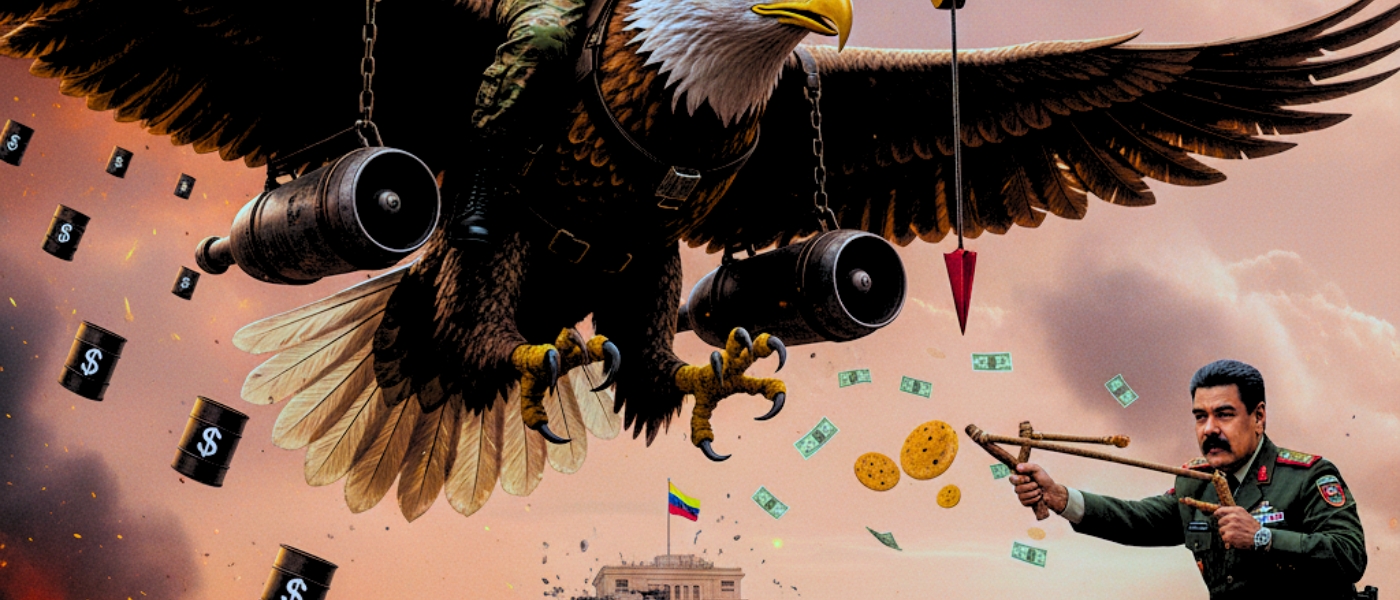
U.S. offensive against Venezuela targeting the Maduro regime
Understanding U.S. policy toward Venezuela requires moving beyond moral narratives and examining hard strategic interests. Washington’s posture toward the Maduro government reflects a convergence of energy security concerns, regional power politics, ideological rivalry, and great-power competition, rather than a single motive or imminent military plan.
Venezuela’s oil reserves and the strategic energy dimension
Venezuela holds the world’s largest proven oil reserves, a fact that has long placed the country at the center of U.S. strategic calculations. While the United States has diversified its energy supply over the past decade, control over global energy flows remains a critical lever of geopolitical power. Washington’s interest in Venezuela is therefore less about immediate supply needs and more about preventing hostile or rival powers from consolidating long-term influence over a strategic energy basin.
Under Nicolás Maduro, Venezuela’s oil sector has increasingly fallen under the shadow of U.S. adversaries, notably China and Russia. These actors have extended financing, technology, and political backing to Caracas in exchange for future energy access and geopolitical alignment. From a U.S. perspective, this represents not merely an economic concern but a structural shift in the balance of power in the Western Hemisphere.
Sanctions targeting PDVSA and Venezuela’s energy exports are designed to constrain the regime’s revenue streams and limit its ability to leverage oil as a geopolitical shield. The objective is not solely punitive; it is strategic containment. By weakening Maduro’s control over oil rents, Washington seeks to erode the regime’s internal cohesion and external bargaining power.
Ideological confrontation and the legacy of Chavismo
U.S. hostility toward the Maduro government cannot be separated from the ideological legacy of Hugo Chávez. Chavismo positioned itself as an explicitly anti-American project, framing U.S. influence as neo-imperial and promoting an alternative political model rooted in state control, populism, and strategic defiance. Maduro inherited this posture, even as Venezuela’s economic capacity to sustain it collapsed.
For Washington, Venezuela under Maduro represents a persistent ideological outlier in a region where most governments have, to varying degrees, reintegrated into global market norms. Allowing such a regime to endure sends a signal that open defiance of U.S.-led institutional frameworks carries limited long-term cost, a precedent the U.S. is reluctant to normalize.
This ideological dimension explains why U.S. policy often emphasizes democratic legitimacy and human rights. While these narratives are selectively applied in global politics, in the Venezuelan case they serve a dual function: delegitimizing Maduro internationally while framing U.S. pressure as normatively justified rather than strategically motivated.
Regional hegemony and control of the western hemisphere
Latin America has historically been viewed by U.S. policymakers as a zone of vital strategic interest. Venezuela’s alignment with non-Western powers challenges this long-standing assumption and weakens Washington’s ability to shape regional outcomes. The persistence of the Maduro regime complicates U.S. diplomacy across the continent, particularly with governments seeking greater strategic autonomy.
Venezuela also functions as a symbolic anchor for anti-U.S. narratives in the region. Its survival under heavy sanctions emboldens other actors to test the limits of U.S. influence, particularly in contexts where domestic legitimacy is fragile. From this standpoint, Maduro’s removal would represent not just a national outcome, but a regional signal.
Furthermore, Venezuela’s political crisis has spillover effects, including mass migration destabilizing neighboring states such as Colombia and Brazil. The U.S. frames these consequences as regional security concerns, reinforcing the argument that Venezuela’s internal governance has external costs requiring sustained pressure.
Great-power competition: China and Russia in Venezuela
Venezuela has become a strategic foothold for China and Russia in the Western Hemisphere, offering both symbolic and material value. For Moscow, support for Maduro provides leverage against U.S. pressure elsewhere, particularly in Eastern Europe. For Beijing, Venezuela represents a long-term investment in energy security and diplomatic influence.
U.S. policy toward Venezuela must therefore be understood within the broader framework of great-power competition. Weakening Maduro is less about Venezuela itself and more about denying strategic depth to U.S. rivals in a region historically dominated by Washington.
This dynamic explains why Venezuela remains a persistent item on the U.S. foreign policy agenda despite limited immediate returns. Allowing adversaries to entrench themselves politically, militarily, or economically in Caracas would undermine U.S. credibility and deterrence far beyond Latin America.
Sanctions, economic warfare, and regime pressure
Economic sanctions are the primary instrument used by the United States to pressure the Maduro government. These measures aim to restrict access to international finance, reduce export revenues, and exacerbate elite-level fractures within the regime. While officially targeted, their broader economic effects are undeniable and controversial.
Critics argue that sanctions have deepened humanitarian suffering without achieving regime change. Supporters counter that Venezuela’s economic collapse predates the most severe sanctions and is rooted in systemic mismanagement. From Washington’s perspective, sanctions are a tool of attrition, designed to raise the long-term cost of regime survival rather than trigger immediate collapse.
Importantly, sanctions also serve a signaling function. They communicate to international markets, corporations, and governments that engagement with Maduro carries reputational and legal risk. This isolates the regime diplomatically and reinforces its dependence on a narrow circle of external patrons.
Domestic U.S. politics and the Venezuelan question
U.S. policy toward Venezuela is also shaped by domestic political considerations. The Venezuelan diaspora, particularly in Florida, exerts influence over electoral dynamics and foreign policy rhetoric. A hardline stance against Maduro plays well with key voter blocs and aligns with broader narratives of opposing socialism and authoritarianism.
Bipartisan consensus on Venezuela, though fragmented in tactics, reflects a rare area of agreement in U.S. politics. Both parties view Maduro as illegitimate, even if they differ on engagement strategies. This consensus limits the scope for dramatic policy reversals, regardless of changes in administration.
As a result, Venezuela functions as both a foreign policy issue and a domestic symbol. It reinforces ideological boundaries within U.S. political discourse and serves as a cautionary reference point in debates over governance, economic models, and state intervention.
Limits of intervention and strategic constraints
Despite aggressive rhetoric, direct military intervention against Venezuela remains unlikely. The costs, legal implications, and regional backlash would far outweigh potential gains. U.S. strategy instead favors sustained pressure, diplomatic isolation, and conditional engagement when it serves broader interests.
Washington is also constrained by shifting global priorities, including competition with China, conflicts in Eastern Europe and the Middle East, and domestic economic challenges. Venezuela is important, but not existential, which explains the incremental and often inconsistent nature of U.S. policy.
Ultimately, U.S. objectives are less about immediate regime overthrow and more about managing decline, limiting rival influence, and shaping post-Maduro transition scenarios. The question is not whether the U.S. wants Maduro gone, but how much cost it is willing to bear—and for how long—to influence Venezuela’s political future.
A strategy of pressure, not invasion
The U.S. approach to Venezuela reflects strategic calculation rather than imminent military ambition. Energy geopolitics, ideological rivalry, regional influence, and great-power competition converge to make the Maduro regime unacceptable to Washington. Yet structural constraints and global priorities limit the tools available.
Rather than a single decisive action, U.S. policy relies on prolonged pressure, economic leverage, and international alignment. Whether this strategy will ultimately reshape Venezuela’s political trajectory remains uncertain, but its logic is rooted firmly in power politics, not moral idealism.